






 Trap
 Normal
Counter Gate
View:
4192
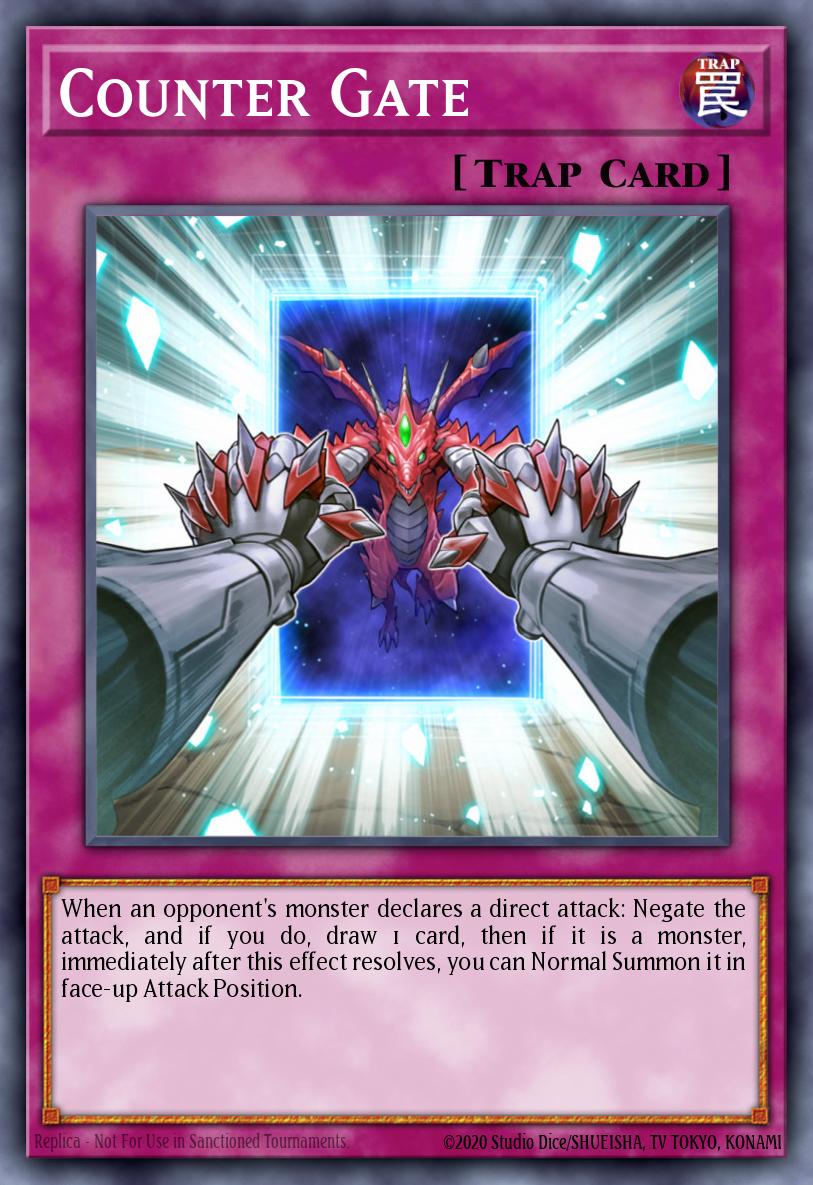
When an opponent's monster declares a direct attack: Negate the attack, and if you do, draw 1 card, then if it is a monster, immediately after this effect resolves, you can Normal Summon it in face-up Attack Position.
Counter Gate — Power Evaluation
Final Score: 53 ± 8 · Confidence: Medium
- Intrinsic: 53 · Deck: 53 · Meta: provisional
- Primary role: Removal / Negation · Secondary: Utility
Why it scores here
Counter Gate is a narrow, cheap trap: it negates a direct attack, replaces itself with one drawn card, and can Normal Summon a drawn monster. Its score comes from being a clean one-copy staple that appears in 26 sampled decks across 19 archetypes, but it does not negate effects, attacks on monsters, or summons, and it has no recorded combo or guide evidence. The high deck count confirms accessibility and cost-efficiency, not raw strength, so it stays in the low 50s.
Axis scores
| Axis | Score | Evidence |
|---|---|---|
| Accessibility | 55 | Appears in all 26 sampled decks at 1.38 average copies and is often paired with Monster Reborn (73.1%), but as a set trap it is not live in the opening hand (observed deck stats, inferred timing). |
| Combo & Conversion | 35 | Text converts a blocked attack into one draw plus a possible Normal Summon, with no recorded combo boards to show further conversion (verified text; no combo data). |
| Resource Economy | 45 | Spends the trap and draws one card, so the card economy is roughly even, with a small bonus if the drawn card is a monster that gets summoned (verified text). |
| Effect & Interaction | 40 | Answers only direct attacks, a narrow but reliable form of opponent interaction that does not stop effects or attacks on monsters (verified text, inferred scope). |
| Material Utility | 10 | Not a body and does not provide material, so this axis only reflects the drawn monster being summonable (inferred from text). |
| Resilience & Flexibility | 35 | Single trap-zone presence with no redundancy or recursion in the evidence, so backrow removal or a non-direct attack can end it (inferred, no combo data). |
| Deck-Building Efficiency | 85 | One-copy slot with no garnet or lock, and it is run across three gameplay types, so it is cheap to include (observed deck stats). |
Calculation
Weight profile: 0.7 Removal/Negation + 0.3 Utility. Intrinsic ≈ 53, Deck ≈ 53, Meta = provisional. Modifiers: none. Final formula: 0.40*Intrinsic + 0.60*Deck
Strengths
- Cheap, one-copy negation of direct attacks that fits almost any deck
- Draws a card, so it is not a pure dead card when it resolves
- Broad deck fit: 26 sampled decks across 19 archetypes and 3 gameplay types
- Clean, unambiguous timing for a trap
Weaknesses
- Only answers direct attacks, so attacks on monsters and effect-based plays are unaffected
- Not live in hand; it must be set and survive until the attack
- No recorded combo or guide evidence to show a conversion engine
- Its value depends on the opponent choosing a direct attack
Counters / choke points
- Opponent attacks monsters instead of attacking directly
- Opponent removes or destroys set backrow (generic category, not in evidence)
- Opponent plays effects that do not involve an attack
Best use
Anti-direct-attack trap with a draw. Decks: Blue-Eyes, Numeron, Railway, Egyptian God, Exodia, Cyber Dragon, Black Luster Soldier. Suggested copies: 1.
Evidence & gaps
- Verified: Text: negates a direct attack, draws 1 if it negates, and can Normal Summon a drawn monster; 26 sampled decks run it at 1.38 average copies (18 decks at 1 copy); Frame and formats: Trap, legal in TCG, OCG, MasterDuel and DuelLinks
- Observed: Monster Reborn co-occurs in 73.1% of its decks; 19 distinct archetypes, with Blue-Eyes and Numeron the largest homes; Gameplay split: 46.2% type 7, 34.6% type 4, 19.2% type 3
- Inferred: Primary role is negation of direct attacks with a draw; Accessibility is moderate because it must be set; Resilience is limited because a single trap zone is exposed to backrow removal
- Data gaps: no combos supplied, so combo conversion is text-only inference no guides supplied no banlist token; assumed 3 copies (unlimited) no usage statistics (StatisticsCard), so archetype inclusion is inferred from the deck sample only